Rodent exclusion differs fundamentally from standard rodenticide baiting. Placing anticoagulant poison stations around a foundation reduces outdoor population pressure, but fails to prevent animals from entering living…
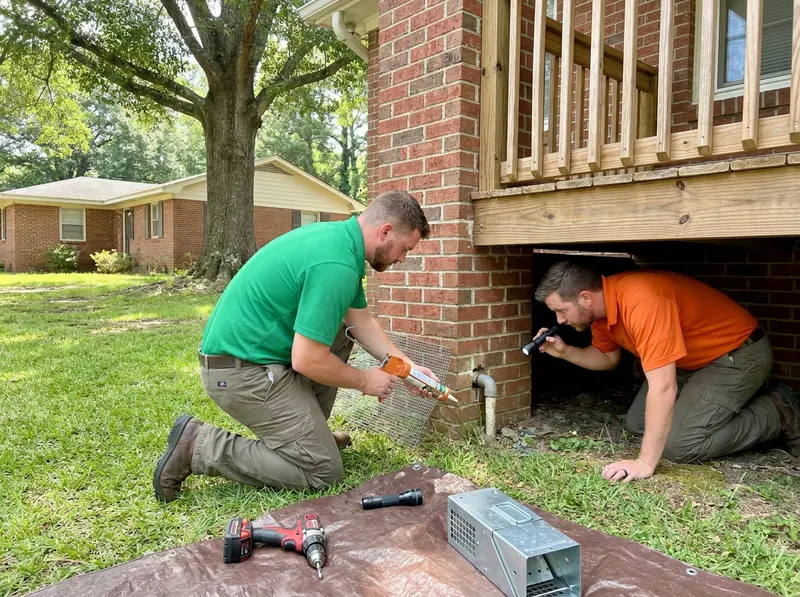
Rodent exclusion differs fundamentally from standard rodenticide baiting. Placing anticoagulant poison stations around a foundation reduces outdoor population pressure, but fails to prevent animals from entering living spaces. When rodents consume bait indoors, carcasses frequently decompose inside wall cavities, producing foul odors and secondary dermestid beetle infestations. Rodent exclusion resolves this biological cycle by sealing architectural gaps larger than 0.25 inches using galvanized 19-gauge steel hardware cloth, metal flashing, and fire-rated expanding foam backing. Trapping occurs simultaneously within interior attics, drop ceilings, and crawlspaces using mechanical snap traps to eliminate trapped populations within 7 to 14 days without chemical drift near children or pets.
Older architectural styles across Summerville and Forest Hills frequently feature raised pier-and-beam foundations with vented crawlspaces, heart-pine soffits, and roofline transitions under mature oak canopies. These structural profiles allow roof rats to enter through 0.5-inch gaps along fascia boards and gable vents. Conversely, mid-century ranch properties in West Augusta and Montclair, as well as slab-on-grade homes in National Hills, more commonly experience Norway rat incursions around degraded foundation weep holes, air conditioning line-set chases, and detached garage door sweeps. High moisture proximity to the Savannah Riverwalk, the Augusta Canal National Heritage Area, and Phinizy Swamp Nature Park elevates exterior rodent density, driving rodents toward indoor heating elements and wall insulation during cooler autumn and winter months.
Historic wood-frame homes in Harrisburg and brick rowhouses in Old Town require breathable copper mesh (Stuf-fit) around masonry weep holes to preserve structural airflow while physically denying mouse access. Properties near Piedmont Augusta Hospital and the Augusta University Summerville Campus often contend with utility pipe penetrations through brick mortar that require cementitious hydraulic patching. The procedural workflow follows three concrete steps:
1. Complete attic, baseline crawlspace, and perimeter inspection to map gnaw marks, rub marks (sebum trails), and entry dimensions.
2. Exterior mechanical exclusion sealing every opening down to 0.25 inches using non-corrosive metals.
3. Dedicated mechanical trap monitoring and removal cycle, concluding with urine and fecal spot enzyme sanitization to neutralize pheromone trails that attract future colonies.
Every job gets a firm, written price after a free on-site visit.
Tell us about your rodent exclusion & removal job in Augusta and we'll send a clear, written quote, usually the same day.
 Trivano Pest Assistance