Silverfish and occasional invaders enter Richmond County homes when seasonal humidity shifts disrupt their outdoor shelter. In historic neighborhoods like Summerville and Old Town, architectural profiles often feature…
Silverfish and occasional invaders enter Richmond County homes when seasonal humidity shifts disrupt their outdoor shelter. In historic neighborhoods like Summerville and Old Town, architectural profiles often feature aged heart-pine framing, plaster lathe, and humid crawlspaces that register relative humidity levels above 70%. These dark environments provide ideal moisture and starchy cellulose food sources for silverfish, earwigs, and house centipedes. Near natural river basins such as the Augusta Canal National Heritage Area and Phinizy Swamp Nature Park, ground moisture saturation routinely forces subterranean arthropods toward drier building slabs. Modern slab-on-grade homes in Montclair, West Augusta, and National Hills experience structural perimeter penetrations through weep holes and expansion joints, especially during mid-summer dry spells when damp-loving pests seek plumbing wall voids.
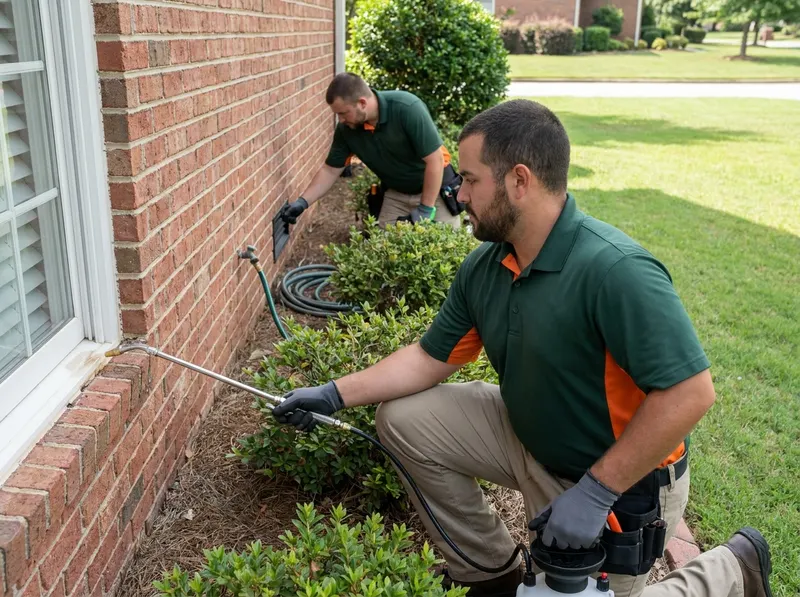
Effective perimeter barrier management functions differently than standard hardware store broadcast foggers. Over-the-counter pyrethroid sprays often create a repellent perimeter that fragments colonies, scattering silverfish deeper into subflooring, insulation layers, and drywall cavities where book bindings and wallpaper paste sustain them. Professional treatment uses non-repellent microencapsulated liquid suspensions applied along the exterior perimeter 3 feet up the foundation wall and 3 feet out onto adjacent soil or gravel. In damp sub-levels, desiccating inorganic dust formulations like amorphous silica gel are injected directly into wall voids and pipe chases. This targeted approach prevents insect survival along utility lines behind washing machines and dishwashers near water-facing corridors like the Savannah Riverwalk, without leaving airborne residues in primary living spaces.
A single targeted perimeter defense protocol fits situations involving sudden seasonal migration or localized moisture incursions around bathrooms and attics. If an active infestation is restricted to one or two damp utility zones, a one-time targeted treatment eliminates the localized colony without locking the property owner into multi-month binding contracts. The trade-off involves environmental control: chemical treatments neutralize active populations for 60 to 90 days, but lasting suppression requires addressing fundamental plumbing leaks or crawlspace ventilation deficits. For homes in Forest Hills, Harrisburg, or Barton Village experiencing concurrent wood decay fungi or widespread structural dampness, physical dehumidification or crawlspace encapsulation must supplement chemical defense to achieve permanent eradication.
Every job gets a firm, written price after a free on-site visit.
Tell us about your silverfish & occasional invader defense job in Augusta and we'll send a clear, written quote, usually the same day.
 Trivano Pest Assistance